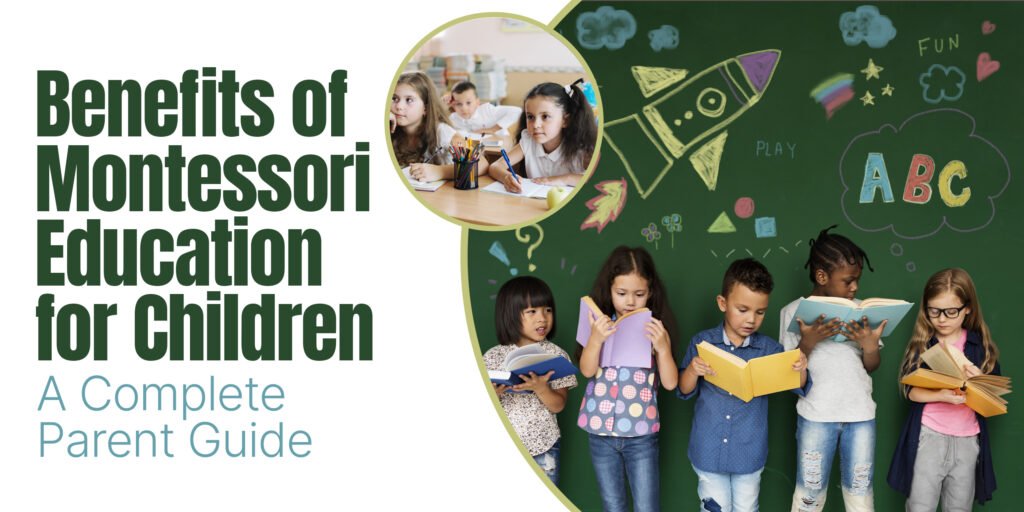
Benefits of Montessori Education for Children – A Complete Parent Guide
Introduction
Many parents today feel unsure whether a traditional classroom or the Montessori method will better support their child’s early development. With different opinions everywhere, it becomes challenging to understand what Montessori truly means and how it impacts a child’s growth.
Montessori education is a child-centred learning approach that encourages independence, hands-on exploration, meaningful activities, and self-paced learning. This method helps children build confidence, strong social behaviour, early learning skills, and emotional stability — all through structured freedom.
At Kidsprep, we follow a modern, child-led Montessori approach that blends Montessori principles with today’s early education needs. Our environment, teaching materials, and classroom design ensure that children learn naturally, joyfully, and holistically.
What is Montessori Education?
Montessori education is a unique learning approach that focuses on how children naturally learn, rather than forcing them into a strict, teacher-led pattern.
The method was created by Dr. Maria Montessori, an Italian physician and early childhood expert who believed that children learn best through hands-on exploration, independence, and freedom within clear limits.
In simple words, Montessori meaning = learning by doing.
Instead of memorizing or copying, children engage in real activities that help them develop:
- Independence
- Focus & concentration
- Problem-solving
- Social skills
- Practical life skills
This approach works especially well for ages 2–6, when children rapidly absorb language, behaviour, movement, and environment. Montessori classrooms give them space to explore, experiment, and grow at their own pace — making learning natural and enjoyable.
At Kidsprep, we incorporate Montessori-inspired materials and activities that help children take the lead while teachers gently guide them.
Core Principles of the Montessori Method
Montessori isn’t just a teaching style — it’s a complete philosophy built around how children think, feel, and learn. Here are the principles explained in a simple, practical way, using examples from Kidsprep classrooms.
1. Prepared Environment
A Montessori classroom is designed for children, not adults. Everything is placed at the child’s height and arranged neatly, so children can explore freely and choose activities independently.
At Kidsprep:
Low shelves, child-sized furniture, sensorial materials, practical life tools, and structured learning corners help children feel confident and responsible.
2. Freedom with Limits
Children are free to choose activities — but within clear, safe boundaries. This helps them learn discipline, respect, and responsibility naturally.
At Kidsprep:
Children pick their work, but teachers guide them to finish one task before starting another, helping them build focus and patience.
3. Auto-Education (Learning by Doing)
Montessori believes children educate themselves when they handle real objects and repeat meaningful activities.
At Kidsprep:
Pouring water, sorting beads, matching shapes, buttoning frames, and sensorial tasks help children understand concepts by actively doing them.
4. Mixed-Age Grouping
Children of different ages learn together (usually 2–6 years). Younger kids learn by observing older ones, and older kids reinforce learning by helping peers.
At Kidsprep:
Group activities, pretend play, and circle time bring mixed-age benefits — cooperation, leadership, and empathy.
5. Respect for the Child
Every child learns differently. Montessori respects each child’s pace, personality, and interests instead of comparing children or rushing them.
At Kidsprep:
Teachers observe each child individually and guide them gently, helping them build confidence and self-esteem.
Key Benefits of Montessori Education for Children
Montessori education creates a learning environment where children grow naturally through curiosity, independence, hands-on exploration, and meaningful activities. Below are the major benefits explained in a simple, parent-friendly way.
1. Independence and Confidence
Montessori activities encourage children to do things on their own, helping them develop confidence and self-belief.
Children learn to:
• Self-feed and manage simple routines
• Pour water, transfer objects, button, zip
• Clean up their workspace
• Choose activities independently
These practical life skills make children more capable, empowered, and confident in their everyday life.
2. Strong Early Learning Foundation
Montessori materials are designed to introduce early concepts through hands-on, sensory-based learning rather than memorization.
Children explore:
• Sensorial tools (shape sorters, color tablets, tactile boards)
• Early literacy activities (phonics, sandpaper letters, picture cards)
• Numeracy tools (number rods, counting beads, spindles)
This builds a strong foundation for reading, writing, math, and structured learning — without pressure or rote methods.
3. Better Social Skills and Cooperation
In Montessori classrooms, children learn in mixed-age groups, which supports healthy social development.
They naturally learn:
• Cooperation and teamwork
• Sharing and turn-taking
• Leadership (older children help younger ones)
• Empathy and respect for others
This environment helps children become socially confident and adaptable.
4. Faster Cognitive Development
Montessori materials challenge children to think, reason, and solve problems independently.
Activities often include:
• Puzzles, matching, sequencing
• Memory-based games
• Hands-on tasks requiring focus
• Activities arranged from simple to complex
These tasks support concentration, logic, decision-making, and overall cognitive growth.
5. Emotional Regulation & Calm Behavior
Montessori environments promote emotional balance by giving children freedom to choose activities and work at their own pace.
This approach helps children:
• Feel more in control
• Reduce frustration and tantrums
• Develop calmness and patience
• Express emotions respectfully
Consistent routines further help children feel secure and emotionally grounded.
6. Creativity & Curiosity Development
Montessori encourages open-ended exploration rather than strict worksheets or passive learning.
Children engage in:
• Art, music, craft, and creative play
• Discovery-based learning
• Sensorial exploration
• Imaginative, real-world activities
This inspires curiosity, imagination, and independent thinking — essential skills for lifelong learning.
7. Real-Life Skill Development
A core Montessori focus is practical life activities that prepare children for real-world tasks.
Children learn skills like:
• Pouring, scooping, wiping, sorting
• Simple food preparation
• Cleaning and organizing
• Caring for plants and their environment
These tasks build independence, discipline, responsibility, and confidence.
8. Respect, Responsibility & Discipline
Montessori discipline is based on freedom within limits, not punishment.
Children learn to:
• Follow routines and classroom rules
• Return materials to their place
• Respect peers, teachers, and materials
• Develop self-control and responsibility
This nurtures respectful, responsible behaviour that stays with children as they grow.
Montessori Activities That Benefit Children (Age 2–6)
Montessori activities are designed to support how young children naturally learn—through movement, hands-on exploration, and meaningful real-life experiences. These activity groups help children build independence, focus, confidence, and early learning skills.
1. Practical Life Activities
- Simple everyday tasks like pouring, buttoning, wiping, or preparing food
- Build independence, coordination, concentration, and responsibility
These activities help children feel capable and confident as they learn to care for themselves and their environment.
2. Sensorial Activities
- Materials that explore colour, size, shapes, textures, and sounds
- Strengthen observation, comparison, and logical thinking
Sensorial work lays the foundation for clear thinking and future academic learning.
3. Early Math Activities
- Hands-on tools like number rods, counting beads, and sandpaper numbers
- Teach numbers, quantities, and early arithmetic in a concrete way
Children understand math concepts naturally instead of memorizing.
4. Language & Literacy Activities
- Phonics-based sound games, sandpaper letters, picture cards, and early reading tools
- Build vocabulary, speaking skills, pre-writing, and reading readiness
Language activities support confident communication and early literacy
5. Creative Arts Activities
- Drawing, painting, craft, music, and free expression
- Encourage imagination, fine motor skills, and emotional expression
Creativity is nurtured through open-ended exploration, not rigid worksheets
6. Social & Group Activities
- Circle time, storytelling, cooperative games, and mixed-age interaction
- Develop sharing, empathy, communication, and teamwork
These activities help children grow into confident, socially aware learners.
Montessori Classroom vs Traditional Classroom – Clear Comparison Table
Below is a simple and clear comparison to help parents understand how Montessori differs from traditional early education.
| Parameter | Montessori Classroom | Traditional Classroom |
|---|---|---|
| Discipline Style | Freedom with limits; natural self-discipline | Rules, instructions, and correction-based |
| Teacher’s Role | Guide/observer who supports exploration | Instructor who directs lessons and activities |
| Learning Approach | Child-led, hands-on, self-paced learning | Teacher-led, uniform pace for all children |
| Learning Materials | Concrete, sensory-rich materials designed for exploration | Worksheets, textbooks, and general learning tools |
| Child Independence | High independence—children choose activities and manage tasks | Limited independence—activities chosen by teacher |
| Outcome | Confidence, independence, problem-solving, emotional regulation | Academic readiness, structured routine, basic discipline |
This table helps parents clearly see how Montessori emphasizes independence and exploration, while traditional systems focus more on structure and instruction.
Is Montessori Good for All Children?
Montessori is an effective learning approach, but its impact can vary depending on a child’s personality and learning style. An honest understanding helps parents make informed decisions.
Montessori works best for children who are:
- Naturally curious and eager to explore
• Active, hands-on learners
• Independent or showing early signs of independence
• More comfortable in calm, structured environments
• Focused when given meaningful tasks
When Montessori may need additional parental support:
- For children who prefer constant direction rather than choosing activities
• For highly energetic children who need time adjusting to calm routines
• For children who struggle with decision-making or open-ended tasks
• For children transitioning from very structured environments
These children can succeed in Montessori — they just need smoother onboarding and consistent guidance from both teachers and parents.
What parents should realistically expect:
- Independence and focus grow gradually, not overnight
• Children learn at their own pace — comparison isn’t encouraged
• Social, emotional, and cognitive growth becomes stronger with consistency
• Montessori builds long-term skills like problem-solving and self-regulation
Montessori is not about rushing learning but nurturing deep and meaningful development.
Why Montessori Education Works So Well for Ages 2–6
The early years are the most important for brain development, which is why Montessori delivers exceptional results for this age group.
Brain Development Window
Between ages 2–6, the brain grows rapidly — especially in language, movement, emotional control, and early cognitive skills. Montessori activities match this natural growth phase.
Sensitive Periods
Dr. Maria Montessori observed “sensitive periods”—times when children are naturally more receptive to learning specific skills.
Examples include:
• Order and routine
• Language development
• Fine motor movement
• Social interaction
• Sensory exploration
Montessori environments support these sensitive periods with targeted, hands-on materials.
Impact of Hands-On Learning
Children learn best when they touch, explore, experiment, and repeat. Montessori materials allow children to:
• Understand concepts through real objects
• Learn through movement
• Build concentration through repetition
• Explore without pressure
This makes learning natural, enjoyable, and developmentally aligned.
Choose the Right Montessori School – Parent Checklist
Not all schools follow true Montessori principles. This checklist helps parents identify an authentic Montessori environment.
What to Look For:
- Mixed-age classrooms (e.g., 2–6 years together)
• Certified Montessori teachers trained in Montessori philosophy
• Authentic Montessori materials like pink tower, number rods, golden beads
• Clean, safe, hygienic environment suitable for young children
• Age-appropriate, hands-on activities across practical life, sensorial, math, and language
• Open communication with parents regarding progress, routine, and behaviour
• A warm, calm, child-centred environment that encourages independence
A good Montessori school feels peaceful, orderly, and designed for children to explore freely — not busy, noisy, or worksheet-driven.
FAQs on Montessori Education for Kids
What age is best to start Montessori?
Typically 2–3 years, when children are curious and ready for hands-on learning.
Is Montessori better than traditional schooling?
Montessori focuses on independence, hands-on learning, and emotional growth, while traditional schools follow structured lessons. The best choice depends on your child.
Does Montessori help with discipline and behavior?
Yes. Freedom with limits teaches self-control, routine-following, and respectful behaviour.
Can Montessori help shy children?
Absolutely. Calm, respectful classrooms and mixed-age groups gently build confidence.
Emotional Regulation & Calm Behavior
Yes. They support sensory exploration, repetition, and self-correction for lasting learning.
How is learning measured in Montessori classrooms?
Through observation of independence, mastery of activities, social skills, and focus—not tests or grades.
Conclusion: Montessori Education – Nurturing Confident, Independent Learners
Montessori education offers children a unique, hands-on approach that builds independence, confidence, social skills, emotional balance, and early learning foundations. Through child-led exploration, practical life activities, sensorial materials, and mixed-age interactions, children develop curiosity, creativity, and lifelong problem-solving abilities.
Choosing the right Montessori school ensures your child thrives in a safe, engaging, and developmentally aligned environment, where learning is joyful and tailored to each child’s pace. By fostering independence, responsibility, and a love for learning, Montessori education prepares children not just for school, but for life.
